

Water Conservation Center (WCC)
The Water Conservation Center (WCC) near Etter TX aims to demonstrate simple techniques and water saving ideas to local farmers that can help them increase their profitability and sustainability in the face of declining water availability. The demonstrations are done on a field scale, using commercial equipment to highlight to producers the economics of water saving ideas and just how accessible real improvements can be on their farm.
Plans for 2026
This year we have an exciting line up of field demonstrations These include:
- The economics of sharing water between early planted silage corn and later planted grain corn. The aim is to spread out peak water demand to ensure a higher yield for each crop.
- A comparison between sprinkler, mobile drip and subsurface drip irrigation. Two spans on each pivot have been converted to PMDI to compare with the standard sprinkler package.
- The use of drought tolerant corn hybrids under limited water conditions. There will be 6 hybrids tested under 4 irrigation levels, with early and late planting.
- The use of Upterra treated water on the west pivot compared to untreated water on the east pivot.
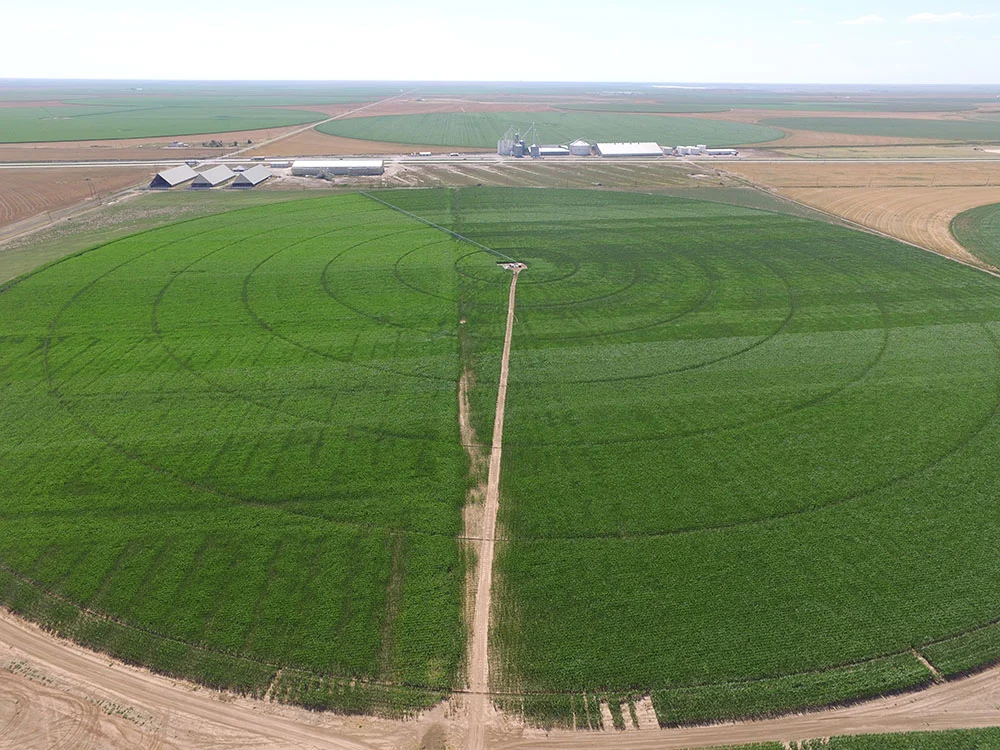
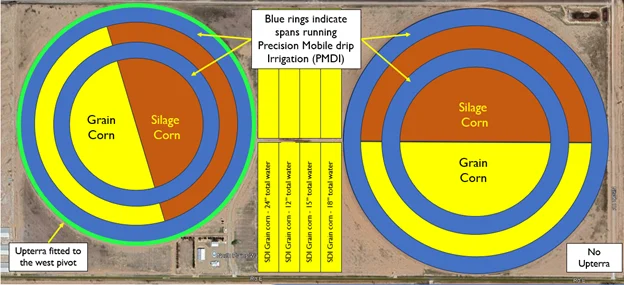
2026 Pivot layout
Pivot layout for 2026 WCC field demonstrations, including grain corn, silage corn, PMDI spans, and Upterra comparison areas.
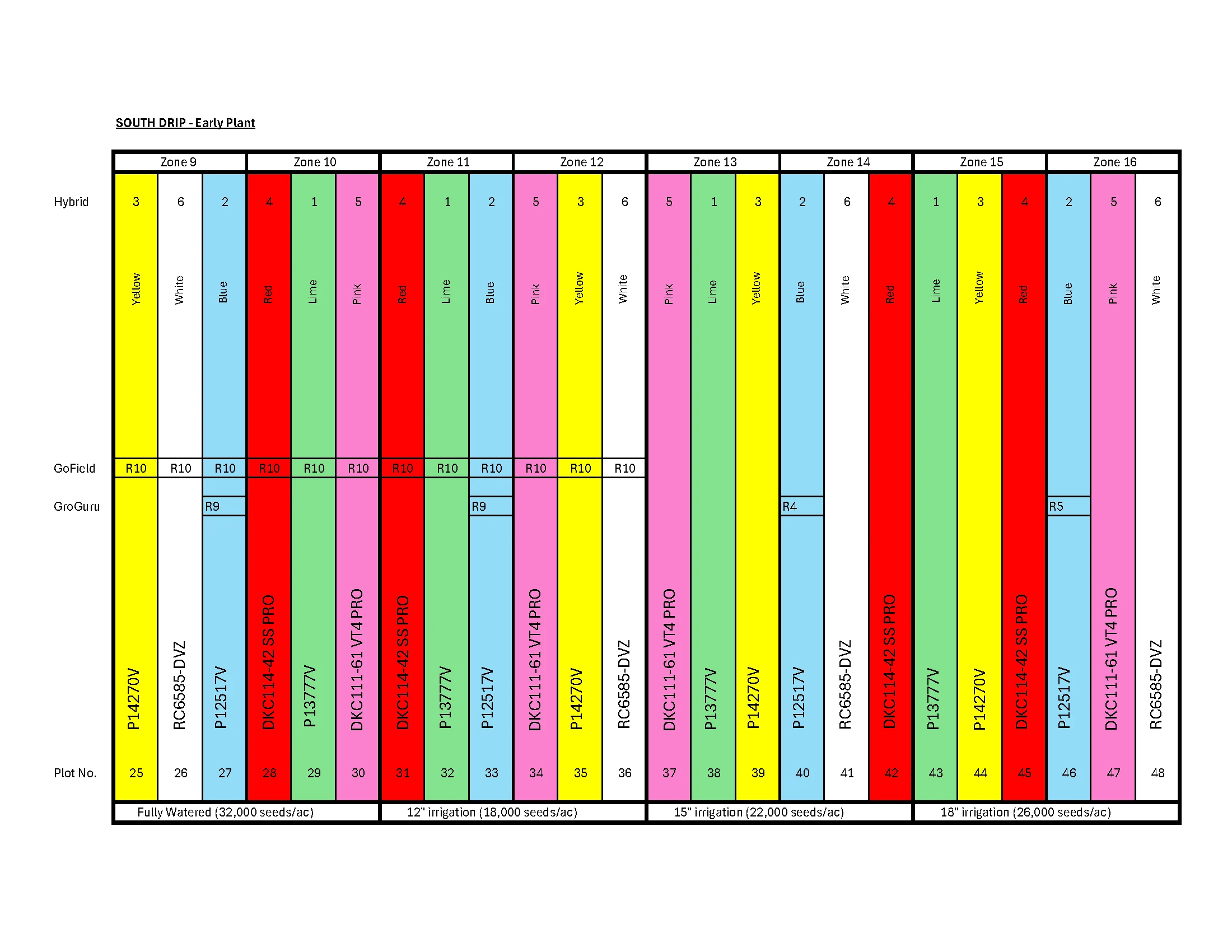
Hybrid and irrigation treatment layout
Hybrid and irrigation treatment layout for the 2026 corn demonstration plots.
After compelling results from 2025, that highlighted just how far new drought tolerant genetics have progressed, we are keen to repeat the demonstration in 2026. There was one hybrid (P14364PCUE AquaMax) that really stood out, providing a yield advantage between 9% & 14% across a range of high and low irrigation regimes. This is exciting as it provides protection against low yields in low water conditions but also provides the opportunity to increase yields if the conditions allow. This year will be similar to 2025, but featuring a new range of hybrids that include rootworm protection, given the corn after corn rotation. We encourage local farmers to come and see for themselves how modern genetics stack up against each other under a range of water limited conditions.
Anyone who has been irrigating in the panhandle over the last 10-15 years would have seen vast changes in the way we irrigate. Sprinkler pads are being flipped to bubble mode, nozzles are lower and closer together, and the pivots are running slower. This year we have made another investment at the WCC and we will be incorporating precision mobile drip irrigation (PMDI) to compare it against the current irrigation practice. By attaching drip lines instead of spray nozzles, we can get the water to the soil surface with minimal losses and give it a longer time to soak. We will be making a thorough comparison between sprinkler and mobile drip when used to grow grain and silage corn. We will also be able to compare these differences with and without the Upterra water treatment system.
Since we will include the same hybrid used to grow grain corn on the pivots in the subsurface drip fields, this will allow us to compare all 3 types of irrigation in a side-by-side matchup. This should prove very compelling when looking at irrigation options for a future where irrigation efficiency is becoming more critical. This comparison should also allow for some modeling of costs versus the return on investment when considering irrigation upgrades, so local producers can decide what might fit with their own operations.
As always, you are welcome to come out and visit the demonstrations at the WCC and encouraged to ask questions and/or follow the updates. We are planning on holding a field day later in the season and we hope to see you there.
For more information about the North Plains Water Conservation Center demonstrations contact Baylee Barnes at 806-935-6401 or bbarnes@northplainsgcd.org.
Video Updates
History of the Water Conservation Center
In 2014, North Plains Groundwater Conservation District began developing the North Plains Research Field near Etter, Texas, into what is now known as the Water Conservation Center. The District’s goal was to create a demonstration field where producers, landowners, and community members could see practical water conservation strategies tested under local growing conditions.
Early demonstrations at the Center focused on irrigation efficiency, crop production, and water-use strategies relevant to producers in the North Plains region. These efforts included work related to the District’s 3-4-5 Demonstration Project and 200-12 Project, both of which helped evaluate irrigation practices and conservation approaches in field-scale settings.
Today, the Water Conservation Center continues to serve as a place for education, demonstration, and applied conservation work. The Center supports the District’s mission by helping show how water-saving practices, irrigation management, and conservation innovation can be applied in real agricultural settings.
